
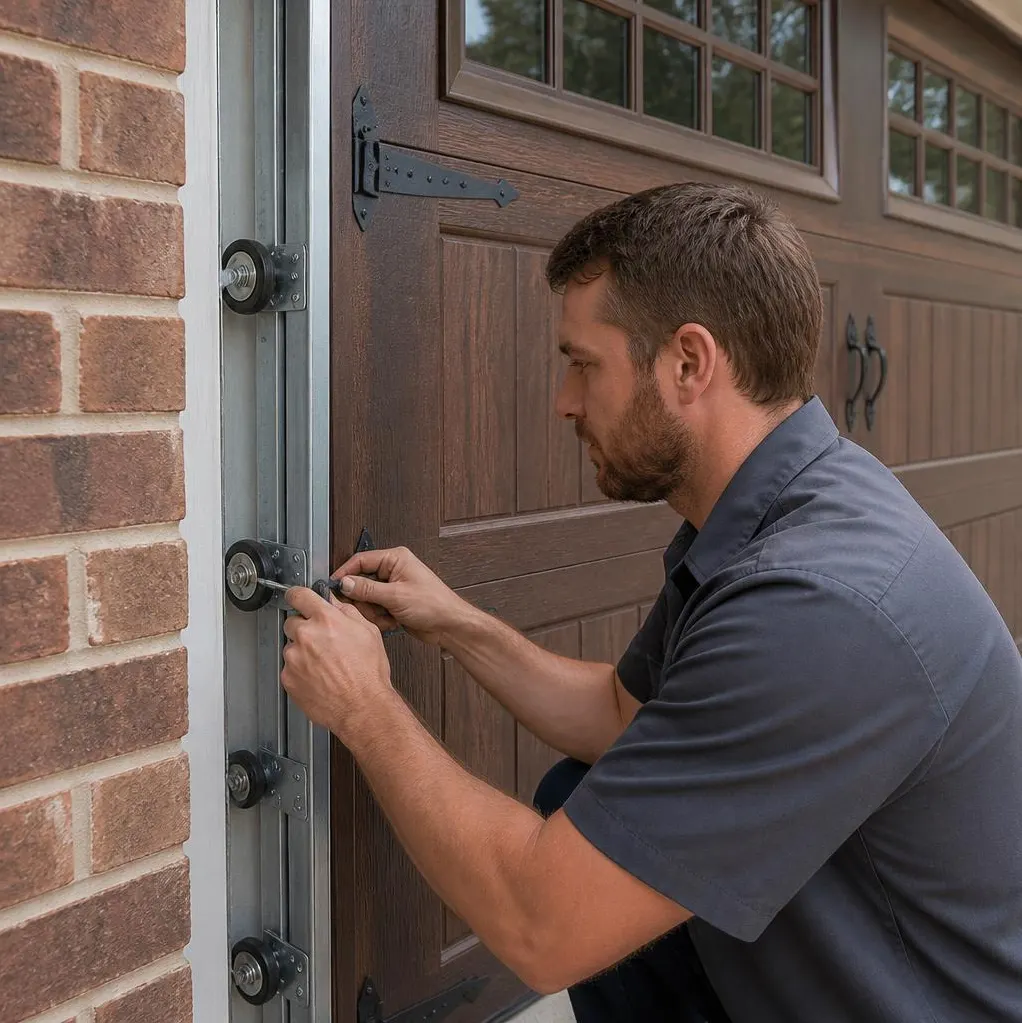
If your garage shares a wall with a bedroom or living space, get a belt drive; if the garage is detached or far from where people sleep, a chain drive will save you money with no real downside. That's the rule of thumb. The exceptions matter here more than in most places: salt air, freeze-thaw winters, and the original heavy wood doors common in older shore houses all push the decision in different directions depending on your setup.
Chain Drive
A metal chain, similar to a bicycle chain, pulls the trolley along a rail to open and close the door. It's the oldest, simplest, and cheapest mechanism, and it's still the most common opener sold today.
- Noise: The loudest of the four options. Metal-on-metal contact creates a rattling, grinding sound that carries through walls and ceilings.
- Price: Typically the least expensive opener unit on the market, often in the $150–$250 range before installation.
- Lifespan: With regular lubrication, 10–15 years is normal. Chains do stretch over time and need periodic tensioning.
- Local note: Salt-laden humid air speeds up surface rust on an unprotected chain. A light coat of garage-door-specific lubricant a couple of times a year keeps corrosion from eating into the links faster than it would inland.
Belt Drive
Same mechanism as a chain drive, but the chain is replaced with a reinforced rubber or polyurethane belt. It's the quietest option for homes where garage noise is a real concern.
- Noise: Noticeably quieter — a soft hum instead of a rattle. Ideal for an attached garage below or beside a bedroom, home office, or converted living space, which is common in shore houses where every square foot gets used.
- Price: Usually $200–$350 for the unit, a modest premium over chain drive.
- Lifespan: Comparable to chain drive, 10–15 years, though the belt itself can degrade faster under constant UV and humidity exposure if the garage faces the sun or sits close to the bay. It's a wear item worth checking for cracking or fraying during routine maintenance.
Screw Drive
A threaded steel rod turns to move the trolley, with fewer moving parts than chain or belt systems. In theory that means less to maintain.
- Noise: Moderate — quieter than chain, louder than belt. Performance depends heavily on how well it's lubricated.
- Price: Mid-range, roughly $180–$300.
- Lifespan: 10–15 years, but screw drives are the most sensitive to temperature swings. The rod expands and contracts with heat and cold, and in a region that cycles between humid summer heat and icy winter nights, that constant expansion and contraction can make the mechanism feel sluggish or noisy until it's relubricated with a temperature-appropriate grease. This isn't a dealbreaker, just a maintenance reality that catches people off guard after their first shore winter.
Direct Drive
A newer design where the motor itself travels along a stationary chain or belt embedded in the rail, rather than pulling a trolley. Fewer moving parts translates into less vibration.
- Noise: The quietest of the four, with almost no vibration transferred to the door frame or ceiling joists.
- Price: The most expensive, typically $300–$450 for the unit.
- Lifespan: Comparable to belt drive, 10–15 years, with the added benefit of fewer parts that can wear out or need adjustment.
- Local note: Because it's compact and quiet, it works well in detached garages that have been converted into guest suites or workshops — a layout that shows up often in older shore properties where the garage was repurposed decades after the house was built.
Side-by-Side Summary
- Quietest to loudest: direct drive, belt drive, screw drive, chain drive.
- Least to most expensive: chain drive, screw drive, belt drive, direct drive.
- Lowest to highest maintenance in this climate: direct drive and belt drive need the least upkeep; chain drive needs regular lubrication to fight salt-air rust; screw drive needs seasonal relubrication to handle freeze-thaw cycles.
- Lifespan: All four land in the same general 10–15 year range when properly maintained — the real differentiator is noise and upkeep, not longevity.
What We'd Recommend for Typical Homes Here
For a standard attached garage in Ocean City, Somers Point, or Linwood where the garage sits next to living space, a belt drive offers the best balance of price and quiet operation. If the garage is detached or sits at the far end of the house — common on some of the older, deeper lots in this area — a chain drive is a perfectly reasonable, budget-friendly choice as long as it gets lubricated on a regular schedule to fight the salt air. Screw drives are a fine middle option but require an owner who's willing to stay on top of seasonal lubrication rather than ignore it. Direct drive is worth the extra cost if the garage doubles as a workshop, office, or guest space where near-silence matters, or if you simply want the lowest-maintenance option available.
Whichever drive type you choose, remember that the original, heavier wood doors found on a lot of older shore houses need an opener rated for that weight. An undersized opener will strain and wear out years ahead of schedule trying to lift a door it wasn't built for.
When to Call Ocean City Garage & Gate
If your current opener is grinding, reversing on its own, or struggling to lift the door — especially after a cold snap or a stretch of nor'easter weather — it's worth having it looked at before the mechanism fails completely. Our Garage Door Opener Service covers diagnosis, lubrication, belt or chain tensioning, and full replacement if the unit is past the point of repair. If an opener upgrade reveals worn or rusted springs underneath — a common finding on older doors along the shore — our Spring Replacement service handles that safely at the same visit.
If you're weighing chain versus belt versus direct drive for a home in Ocean City, Somers Point, Linwood, Northfield, Margate City, Ventnor City, Longport, or Egg Harbor Township, give Ocean City Garage & Gate a call. We'll walk through your garage's layout, your door's weight, and your noise tolerance, then recommend the opener that actually fits your house.